
Crypto's trading slowdown exposed a widening gap last week between Robinhood and Coinbase. Both companies generated less revenue from digital assets in the most recent quarter, but Robinhood's expanding options, equities, and prediction markets businesses more than filled the void, while Coinbase had no comparable engine to cushion the decline.
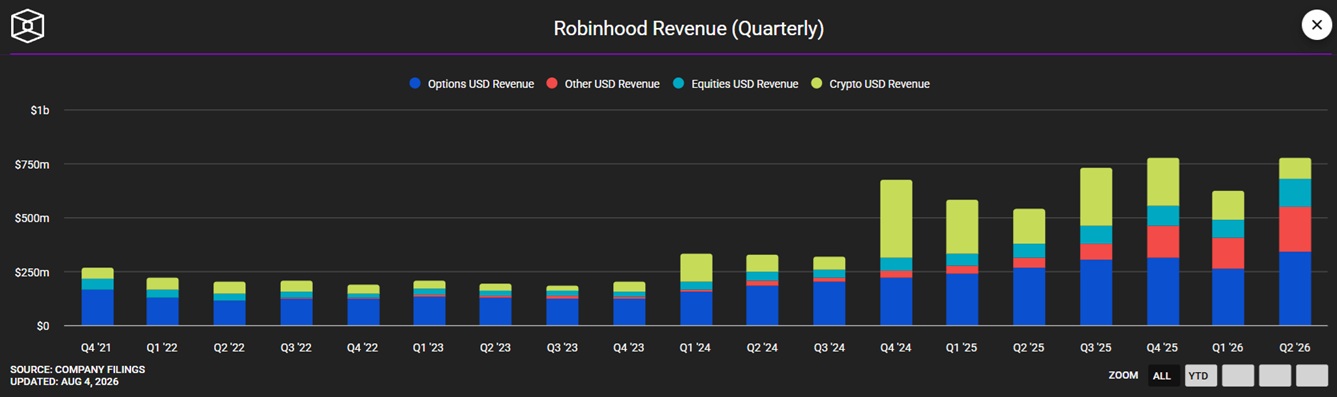
Robinhood's crypto transaction revenue fell to $100 million in the second quarter of 2026, down 37.5% year-over-year, even as the company posted record numbers elsewhere in the business.
Crypto now accounts for just 13% of Robinhood's (HOOD) transaction revenue, as crypto trading volumes fell another 23% quarter-over-quarter, its lowest since the fourth quarter of 2023.
Despite this, the company's total transaction revenue of $776 million matched its Q4 2025 record, while the composition of that revenue has completely shifted. Options revenue hit a record $342 million, up over 31% quarter over quarter. Equities revenue also hit a record $129 million, up 95% from the same period last year.
Robinhood's event contracts (prediction markets) generated $156 million in revenue on 13.6 billion contracts traded. That's a 50% increase from last quarter, marking the first period in which Robinhood's prediction markets business out-earned its crypto business.
Robinhood’s retail crypto business used to be the largest driver of the company’s transaction revenue in late 2024, but has now fallen behind options, event contracts, and equities. The striking part is that this has not negatively affected the company’s top line, as its other business lines have offset the decline in crypto.
The successful diversification and expansion of its revenue mix came from replacing crypto beta with a product line that monetizes sports and politics, and is a strategic pivot that will likely boost its second-half numbers, with the start of the NFL season and the U.S. midterms.
Looking at Coinbase
Speaking of successful revenue diversification and well-executed strategic decisions, Coinbase (COIN) has evidently done neither.
The U.S. crypto exchange reported $1.22 billion of total revenue in the second quarter, its weakest since the third quarter of 2024. Total trading volumes fell 24% quarter over quarter, its lowest quarterly figure since Q3 2023, with both institutional and retail volume falling equally. Transaction revenue fell 20%, while transactional gross profit fell 27%.
The company’s gross margin on transaction revenue also fell to 68%, from 74% the previous quarter. Though on the bright side, adjusted EBITDA came in at $208 million, keeping a 14-quarter positive streak alive.
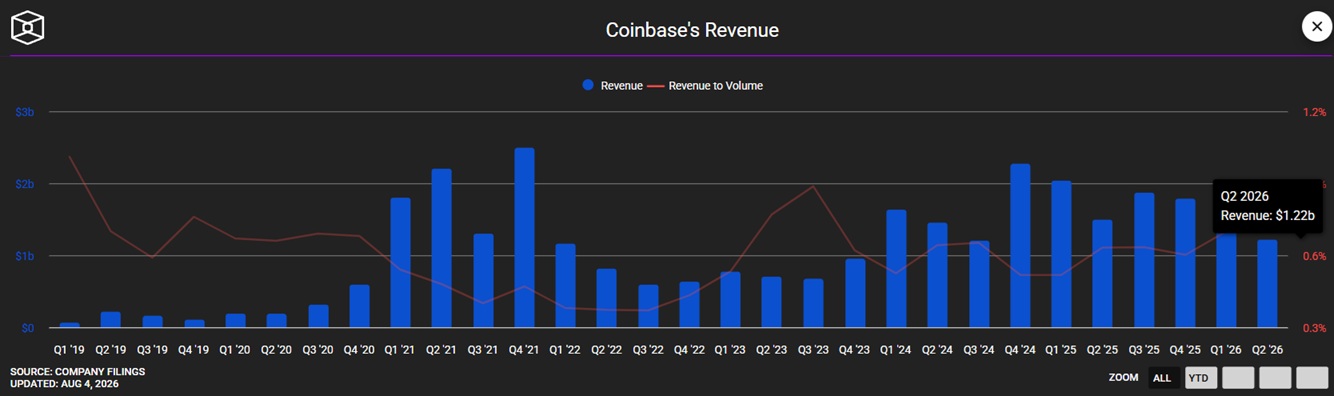
While these poor numbers may be seen as an effect of the broader crypto market-wide drawdown, it is worth noting that Robinhood also faced the same market conditions, yet only one of them managed to post record numbers.
Robinhood's prediction market business alone generated $156 million in Q2, while Coinbase's prediction markets business just crossed $100 million on an annualized basis, roughly a sixth of Robinhood's quarterly run rate.
Coinbase’s Q3 guidance points to transaction revenue running roughly 24% below Q2's daily pace through late July, and the market responded accordingly
COIN shares declined by over 10% post-earnings, extending its year-to-date losses to 36%, now approaching its lowest level since February 2024.
This is an excerpt from The Block's Data & Insights newsletter. Dig into the numbers making up the industry's most thought-provoking trends.